
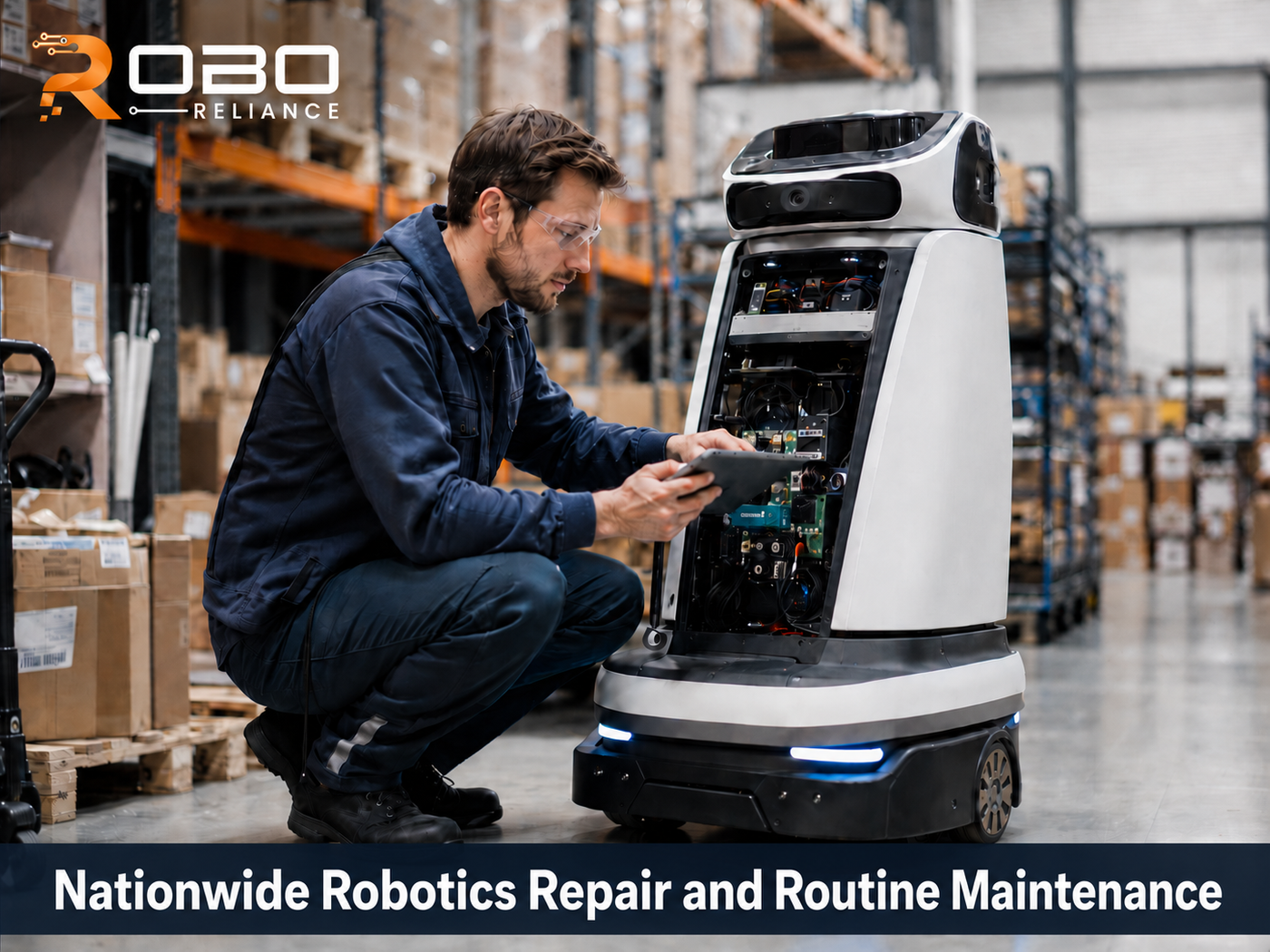
Field service for commercial robotics is the installation, maintenance, and repair of deployed robotic systems in customer environments. It includes scheduled preventive maintenance, on-demand repair, software updates, parts replacement, and end-of-life decommissioning. Robotics manufacturers either build this capability in-house or work with a dedicated field service partner like Robo Reliance, which operates a nationwide technician network across the United States.
Why field service matters more for robotics than traditional equipment
Commercial robots aren't installed and forgotten. They run hard. A food prep robot might cycle through thousands of operations per shift. A warehouse AMR might log fifteen hours of motion per day. A humanoid in a clinical setting interacts with patients and staff every shift change.
That intensity creates a different service profile than traditional commercial equipment. Three things make robotics field service uniquely demanding.
Uptime is revenue. When a commercial oven goes down, the kitchen reroutes orders. When a robot goes down, the customer loses the throughput the robot was hired to deliver. Every hour of downtime translates directly to operational impact.
The technology is moving fast. Software updates ship monthly. Hardware revisions ship quarterly. A technician who serviced a unit six months ago may be looking at a substantially different machine today. Documentation and training have to keep up.
Distribution is geographically scattered. A robotics company with 50 customers may have units deployed across 30 states. Building a service team that can respond within four hours nationwide is a logistics problem, not just a technical one.
These three pressures combine to make field service one of the hardest operational problems a robotics company faces. It's also the one most likely to be underestimated until the first wave of service tickets lands.
What field service typically includes
A complete field service program for commercial robotics covers five functions:
Installation and commissioning. Site assessment, physical install, network and power integration, software configuration, customer training, and acceptance testing.
Preventive maintenance. Scheduled visits to inspect, clean, calibrate, and replace wear parts before they cause downtime. Cadence varies by application but typically runs monthly to quarterly.
On-demand repair. Response to unplanned failures. This includes remote diagnostics, parts dispatch, on-site repair, and root cause documentation.
Software updates and field upgrades. Pushing firmware, deploying patches, and executing hardware revisions in deployed units without bringing them back to the factory.
End-of-life decommissioning. Safe removal, parts recovery, customer site restoration, and asset disposition when a unit reaches end of service.
A field service partner that only covers two or three of these is not a complete solution. The work doesn't disappear. It falls back on the manufacturer's engineering team.
Build in-house or partner with a field service company
Most robotics founders start by assuming they'll build field service in-house. It seems straightforward. Hire a few technicians. Stand up a dispatch system. Done.
The math gets harder fast.
Cost of in-house field service:
- Fully loaded technician cost: $90,000 to $130,000 per technician per year, plus vehicle, tools, and travel
- Coverage requirement: typically one technician per 15 to 25 units in a region
- Geographic coverage: to serve 30 states with four-hour response, you need roughly 25 to 40 technicians
- Total annual cost for nationwide in-house coverage: $3M to $6M before parts and dispatch overhead
Cost of partnering:
- Variable cost per service ticket
- No technician benefits, vehicles, or recruiting overhead
- Coverage that scales up and down with deployment volume
- Engineering team stays focused on the product
The decision frame is straightforward. If you're a robotics company with under 200 deployed units, partnering is almost always more capital-efficient. If you're a robotics company with over 1,000 deployed units in concentrated markets, in-house starts to make sense. Most companies sit in the middle and benefit from a hybrid model where a partner handles geographic gaps and overflow.
The other variable is time. Building an in-house service organization takes 18 to 24 months. Most robotics companies don't have that runway between their first deployment and their first service crisis.
What to look for in a robotics field service partner
Not every field service company can service robots. Most can't. When you're evaluating a partner, look for five things.
Robotics-specific experience. A technician who has serviced industrial robots, AMRs, or humanoid systems is fundamentally different from one who has only worked on commercial appliances. Ask for case studies. Ask what they've taken apart.
Geographic coverage that matches your deployment map. Don't assume nationwide coverage means actual technicians in your markets. Ask for the technician footprint by zip code or region.
Response time guarantees. A partner that promises four-hour response in major metros and 24-hour response in secondary markets is honest. A partner that promises four-hour response everywhere is overselling.
Documentation and reporting discipline. Every service ticket should produce a structured report. Without that data, you can't track failure modes, improve next-generation hardware, or hold the partner accountable.
Cultural fit with a robotics company. Field service partners that come from traditional appliance or HVAC backgrounds often struggle with the pace of change in robotics. Look for partners that understand iteration, software-defined hardware, and the operating tempo of a venture-backed company.
How Robo Reliance approaches field service
Robo Reliance was built specifically for the commercial, industrial, and home robotics category. We service robotics manufacturers and operators in food service, warehouse and logistics, agriculture, healthcare, and humanoid robotics.
Our model is built on three things.
A nationwide technician network. We deploy technicians across the United States, with concentration in the markets where commercial robotics is being deployed today. We scale coverage with our partners as their deployment maps grow.
Robotics-first training. Every technician is trained on the specific platforms they service. We don't expect a generalist to figure it out on site. We do the platform-specific onboarding before the first ticket.
Engineering-grade documentation. Every service event produces a structured report that goes back to the manufacturer's engineering team. The data flows both ways, which means our partners get smarter about their hardware over time, not just faster at fixing it.
We work with robotics companies that would rather spend their engineering hours improving the next generation of their product than flying technicians to fix the current one.
Frequently asked questions
Who provides field service for commercial robots?
Field service for commercial robots is provided either by the robotics manufacturer's in-house team or by a dedicated field service partner. Robo Reliance is one of the few field service companies built specifically for commercial, industrial, and home robotics, with a nationwide technician network covering the United States.
How much does robotics field service cost?
Costs vary by application, response time requirements, and visit frequency. Preventive maintenance visits typically run a few hundred dollars per unit per visit. On-demand repair is priced by ticket and travel time. Building the same coverage in-house typically costs $3M to $6M per year for nationwide reach.
Can a robotics startup outsource field service?
Yes. Most robotics startups under 200 deployed units are better off partnering than building in-house. Partnering preserves engineering capacity for product development, scales variable costs with deployment volume, and provides geographic coverage that would take 18 to 24 months to build internally.
What's the difference between OEM service and an independent field service partner?
OEM service is provided by the manufacturer's own employees. An independent field service partner like Robo Reliance is contracted by the manufacturer to provide the same service through a dedicated technician network. The advantage of an independent partner is geographic scale, lower fixed cost, and faster time to coverage.
How fast can Robo Reliance respond to a service request?
Response times depend on geography and contract terms. In major metro areas, we target same-day response. In secondary markets, we target 24-hour response. Specific service level agreements are set per partner and per deployment region.
If you're a robotics company deploying in the field and starting to feel the weight of service operations, we should talk.
Robo Reliance keeps robots running so you can keep building.
info@roboreliance.com
800-838-0156
https://www.roboreliance.com/