
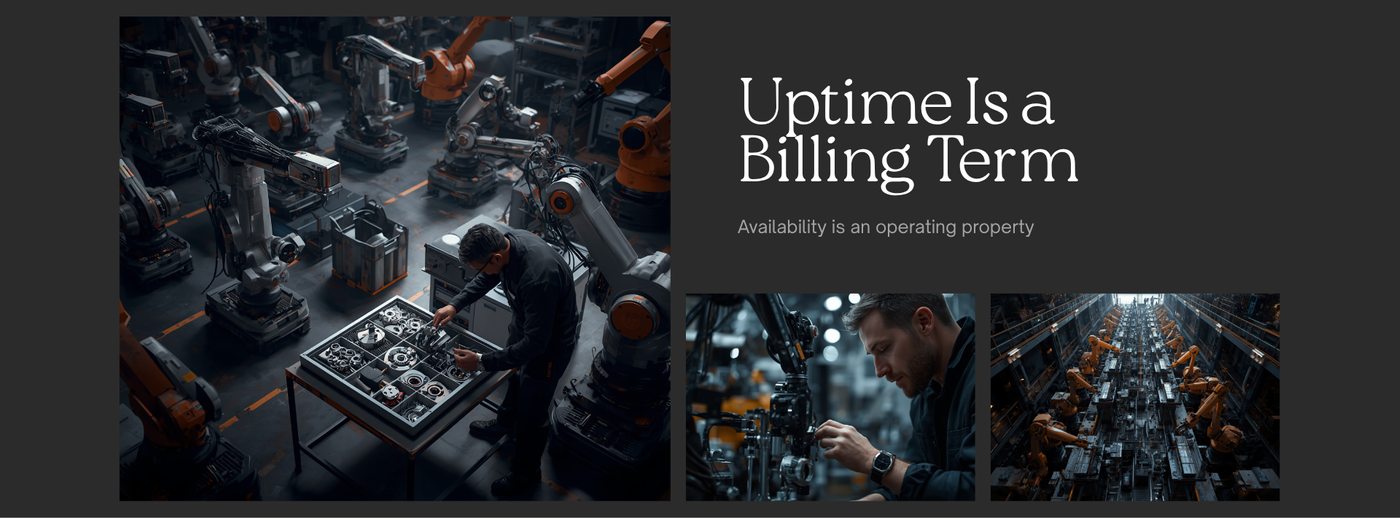
Robotics as a service has become a default way robots get bought. Depending on whose numbers you use, subscription and service models now account for something like 35 to 40 percent of commercial robot deployments. That shift changed the sales conversation. Instead of a capital request, you get a monthly rate, maintenance included, and an uptime number written into the contract.
That uptime number deserves more scrutiny than it usually gets.
Run the math before you sign
Uptime percentages sound precise and hide a lot. Take a unit running two shifts, roughly 80 hours a week. At 99.9 percent availability you are allowed about five minutes of downtime a week. At 99 percent you are allowed 48 minutes. At 97 percent, which is closer to what plenty of real fleets deliver in year two, you are looking at two and a half hours a week per unit. Across twelve units that is thirty hours of lost production every week.
Then read the definitions. Most agreements do not count scheduled maintenance against uptime. Many exclude downtime caused by facility power, network issues, environmental conditions, operator error, or anything the vendor classifies as misuse. Some start the clock when a ticket is opened rather than when the robot stopped. None of those exclusions are unreasonable on their own. Stacked together, they can mean the contractual uptime figure and the number your plant manager would give you are describing two different things.
A service credit is not a recovery plan
The remedy in most uptime clauses is a credit against the subscription fee. Compare that to what downtime actually costs you. If a cell is down for a shift, the loss is not the prorated lease payment. It is idle labor standing next to it, an order that ships late, overtime to catch up, and the confidence of whoever runs that line. A credit reimburses the cheapest part of the problem.
This is not an argument against uptime commitments. It is an argument for reading them as financial terms rather than as an operating plan. The operating plan is separate, and it is yours to build.
The questions that tell you more than the percentage
Ask these before the number matters.
Who physically shows up, and are they employed by the vendor or subcontracted? Many robotics companies sell nationally and cover the map through a patchwork of partners with varying depth.
What can be fixed remotely and what requires hands? Fleet software, remote monitoring, and over the air updates are genuinely good and resolve a real share of tickets. They do not replace a bearing.
Where are the spare parts, and what is the lead time on the long pole items? Drives, harnesses, and sensors on specialized platforms can run weeks out. A critical spares list held locally changes your recovery time more than any clause in the agreement.
Who owns the fault when the answer is not obvious? A conveyor handoff problem is not a robot problem, but the robot stops. Someone has to be willing to own the diagnosis and not just the component.
What happens as the fleet gets mixed? Most operations that keep automating end up with two, three, or four brands on one floor, each with its own contract, portal, escalation path, and definition of uptime. That coordination burden falls on your team by default.
Availability is an operating property, not a purchase
The uncomfortable truth about deployed robots is that reliability is not something you buy once. It is something a floor sustains. The fleets we see performing well have a few things in common, and none of them are contractual.
Preventive maintenance is scheduled on duty cycle rather than on the calendar, because a unit running 80 hours a week wears differently than one running 20.
Somebody local can do the first level of diagnosis. Not repair everything. Just triage well enough to tell a five minute reset from a real fault and to open a useful ticket instead of a vague one.
Failures get logged and reviewed. Patterns show up on the third or fourth occurrence, not the first.
Spares for the parts that stop production sit on site rather than in transit.
Where we fit
Robo Reliance does field service and preventive maintenance on deployed robot fleets, vendor agnostic and across brands. We exist because this industry is very good at building and deploying robots and much quieter about the years afterward. Builders are optimized to ship the next generation, not to stand up a national service organization, and that gap is where fleet owners get stuck.
We are not going to tell you what your uptime clause should say. We will tell you that the number in it is a billing term. What keeps your line moving is a maintenance program, a spares strategy, and someone who answers when a machine stops.
If you are running robots past the pilot stage, or running more than one brand on the same floor, we are glad to talk through what your service model actually needs to look like.
https://www.roboreliance.com | 800-838-0156 | info@roboreliance.com
Word count: 843 (body)