
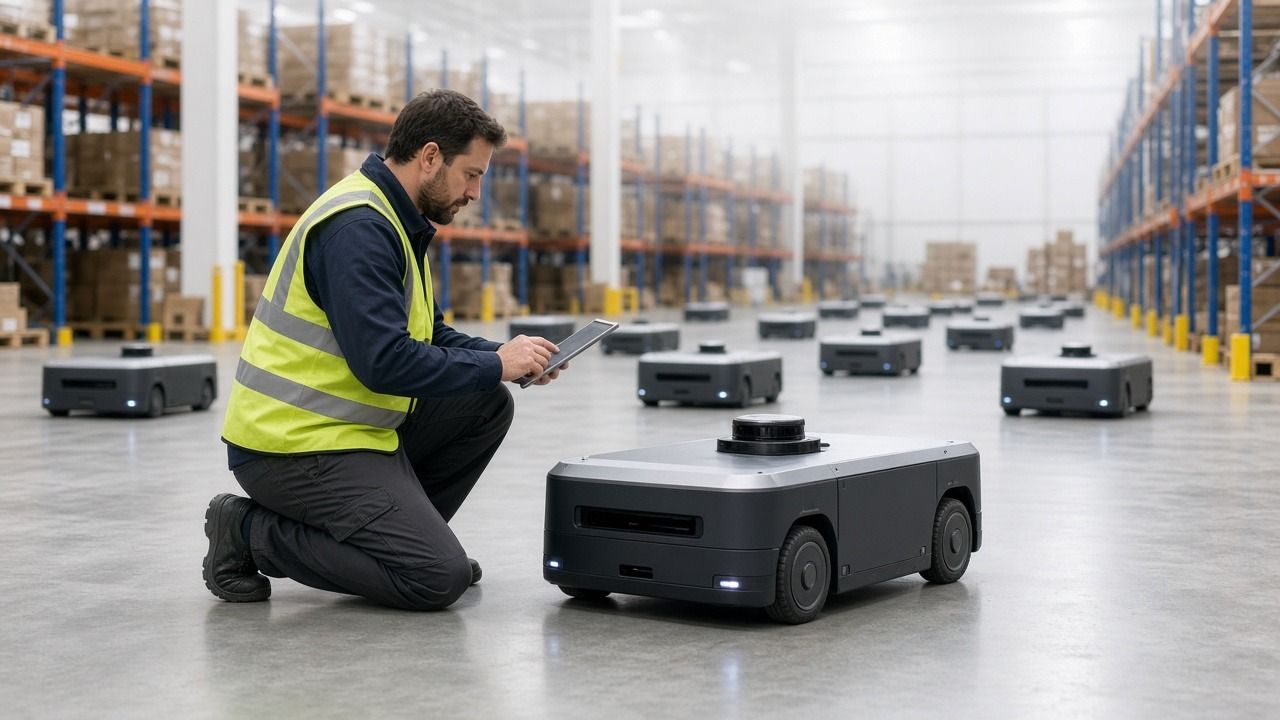
This month Hai Robotics announced what it called the world’s largest deployment of rack-climbing warehouse robots: more than 1,500 units for a European fashion retailer, running a 30,000 square meter fulfillment operation with 1.2 million storage locations and a planned throughput above 24,000 totes per hour. It is a big milestone for the category, and a sign of where warehouse automation is heading. Fleets are no longer dozens of robots. They are hundreds and, increasingly, thousands.
That shift changes the service question in a way that is easy to miss. At small scale, a robot failure is an event. At large scale, it is a daily routine.
Do the math on your own fleet
Here is a simple way to see it. The numbers below are hypothetical, chosen to be generous to the equipment, and they are not a claim about any specific brand.
Say you run 1,500 robots, 20 hours a day. That is 30,000 robot operating hours every day. Now assume the robots are very reliable, and each one needs a human to intervene only once every 2,000 operating hours. That could be a jam, a sensor that needs cleaning, a battery issue, a wheel, a software fault that needs a reset and a look.
30,000 hours divided by 2,000 hours per intervention is 15 interventions a day. That is 105 a week.
Double the reliability to one intervention every 4,000 hours, and you still get 7.5 a day, or more than 50 a week.
Scale it down to a 40-robot site on the same assumptions and you get 800 operating hours a day, or one intervention every two and a half days. Manageable, and easy to handle informally. That is exactly why it is dangerous: the habits a team builds at 40 robots do not survive 400, let alone 1,500.
The point is not the specific number. It is that at fleet scale, “the robot broke” stops being an exception and becomes part of the daily operating load. You do not plan for it the way you plan for a rare breakdown. You staff for it the way you staff for any other recurring work.
What changes when failure is routine
When interventions happen every day, a few things become true at once.
Someone has to own the queue. A fleet with 15 open issues a day needs a person, not a shared inbox, deciding what gets handled first and what can wait for the next shift.
Most issues should never need a specialist. The bulk of daily interventions on a large fleet are first-level work: clear it, clean it, reseat it, reset it, log it. Your own people can handle those if they are trained and have clear procedures. The goal is to keep the technician’s time for the problems that actually need a technician.
Logging stops being optional. At 100 interventions a week, patterns show up fast if anyone is writing them down. The same unit failing every Tuesday, the same aisle causing jams, the same part wearing out early. Without a log, every fix is the first time. With one, you can move work from reactive to preventive.
Spares become an operating decision. If a certain part fails a few times a month across the fleet, waiting on a shipment every time is not a plan. Know which parts your fleet actually consumes and keep them on site.
The escalation path matters more than the robot
On a large site, the real test of a service model is not whether a robot can be fixed. It is whether the right fix reaches the right robot without the floor slowing down.
That means a clear escalation path. What does the on-site team handle? When do they call remote support? When does a field technician need to be on site, and who sends them? What happens when the problem is in the software, the network, or the building instead of the robot?
On a single-vendor floor, the OEM may answer some of those questions. On a mixed fleet, and most large sites become mixed over time, nobody answers them unless the operator decides who does.
Staff for the fleet you are building
If you are planning a deployment in the hundreds, build the service model at the same time as the layout. Estimate your daily intervention load using your own vendor’s reliability data, not a brochure number. Decide who handles first-level work on each shift. Train them before go-live. Set up a failure log from day one. Stock the parts the fleet will eat. Put the escalation path in writing.
None of this takes away from the equipment. The robots on the market today are impressive. It just recognizes that anything running at this scale needs a maintenance operation, and that operation does not appear on its own.
Robo Reliance is a vendor-agnostic field service company for commercial robot fleets. We help operators set up first-level programs, build preventive maintenance around real duty cycles, and provide field technicians across brands for the work that needs one. If your fleet is growing faster than your service plan, let’s talk.
https://www.roboreliance.com | 800-838-0156 | info@roboreliance.com