September was a busy month for robotics deals. Cognex agreed to acquire the depth-camera maker RealSense. Qualcomm agreed to acquire PickNik, the company behind the widely used MoveIt motion-planning software, and The Robot Report noted Qualcomm's pledge to keep MoveIt open source. Those are two of several transactions Robotics 24/7 counted in its monthly recap.
Earlier this year, 36Kr reported on the first wave of shutdowns among humanoid robot makers in China, as the market shifted from demos to production requirements and not every company made the turn.
None of this is unusual. Young industries consolidate. Some companies get bought, some merge, some change direction, and some close. That is how markets mature, and plenty of acquisitions end up good for customers.
But if you own a robot fleet, it raises a question most purchase decisions never address: what happens to your robots if the company that sold them changes?
The robot outlives the org chart
A warehouse or factory robot is a multi-year asset, usually bought with the expectation that it will run for years. Over that span, the vendor you bought from may get new owners, new priorities, a new product line, or a new support model. The people who trained your team may move on. The product you bought may become the old product.
Your floor does not care about any of that. The robots still have to run on Monday.
When a vendor changes hands, the things that tend to shift first are rarely the things on the sales slide. They are the quiet parts of ownership:
Spare parts. Parts for older or discontinued models can get harder to find, and lead times stretch.
Software and firmware. Update schedules change. Older models may stop receiving updates, or updates may require newer hardware.
Cloud dependence. Some robots rely on vendor-hosted services for fleet management, mapping, or licensing. Robotics writer Aaron Prather has argued for end-of-life standards in the industry for exactly this reason: when a cloud service goes away, hardware can stop working entirely.
People. The field engineer who knew your site and your quirks may not be part of the new structure.
Priorities. A new owner may care most about the next platform, which is a reasonable business choice that can still leave your installed base waiting.
None of this requires anyone to act in bad faith. It is simply what happens when ownership changes and resources get reallocated.
Questions to ask before the next purchase
The best time to protect yourself is before the purchase order is signed. A few questions worth putting to any robot vendor, in writing:
How long will you commit to supplying spare parts for this model, and what happens to that commitment if the company is acquired?
Can the robots operate locally if your cloud service is unavailable, and for how long?
Will you provide service documentation, diagnostic tools, and training to our team or to a third-party service provider?
Does using a qualified third-party service provider affect the warranty?
What is your end-of-life policy, including how much notice you give before a product is discontinued?
Is there any provision for software escrow, or for license continuity if the company changes hands?
You will not always get the answer you want. Some vendors will not commit to much. But the answers tell you how much risk you are taking on, and that belongs in the buying decision as much as the price does.
What to do with the fleet you already own
If your robots are already on the floor, you cannot go back and renegotiate the contract. You can reduce your exposure.
Build an honest asset register. Every unit, its model, serial number, firmware version, hours run, and service history. If your vendor relationship changes, this record is what lets anyone else pick up where they left off.
Stock critical spares now. Identify the parts that fail most often and the parts with the longest lead times. Hold enough of both that a supply hiccup does not become a shutdown.
Keep your own logs. Do not rely only on the vendor's dashboard. Export fault data and maintenance records regularly and keep them somewhere you control.
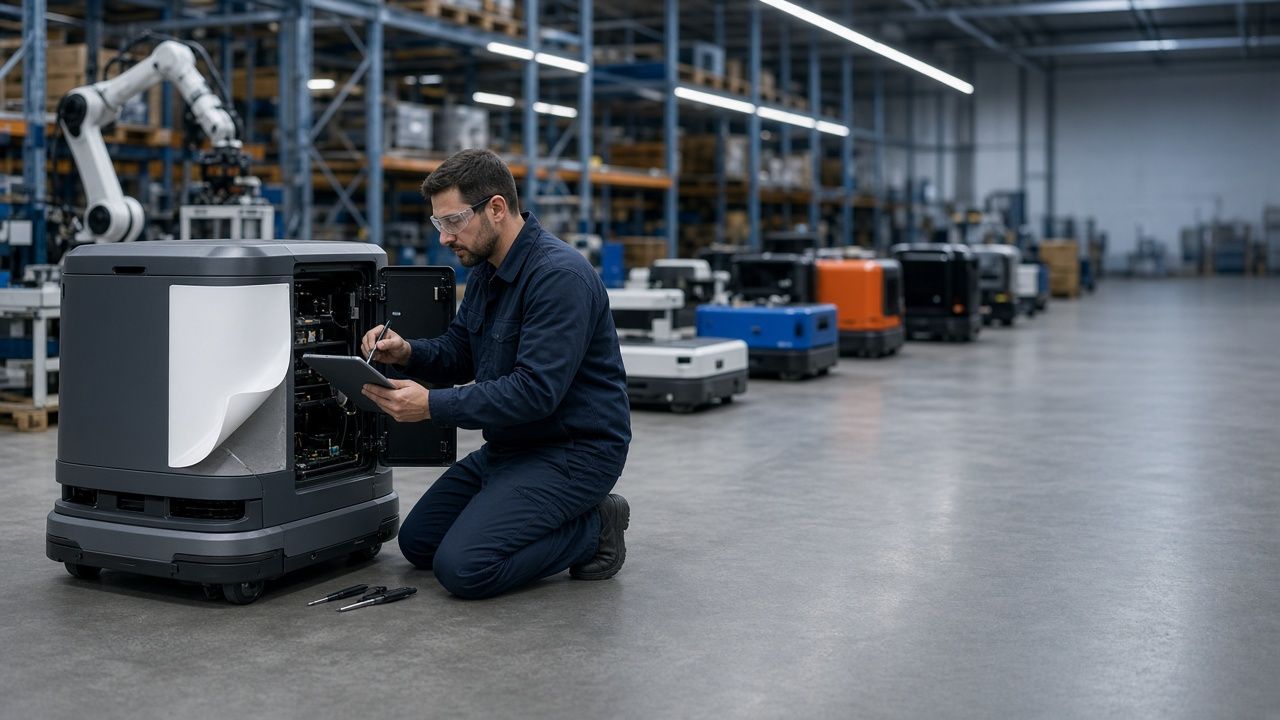
Build first-level skills in house. A small amount of training on your own team goes a long way. People who can clean sensors, swap common parts, reseat connectors, and read basic fault codes keep minor issues minor.
Know who else can work on your fleet. Do not wait for a crisis to find out whether anyone besides the original vendor can service your equipment.
This is the case for vendor-agnostic service
Most fleets end up with more than one brand over time, and most operators end up managing several separate service relationships. Consolidation adds another layer: the brand on your robots may not be the brand supporting them in three years.
A vendor-agnostic service partner is built for that reality. The relationship is with your fleet, not with any single manufacturer's roadmap. Service history, spares planning, and preventive maintenance stay continuous even when the logos on the equipment change hands.
That is the work Robo Reliance does. We service and maintain robot fleets across brands, built by operators who have run multi-site field service businesses and who know a robot is only worth what it produces while it is running. If you want a second set of eyes on how exposed your fleet would be to a vendor change, we are glad to walk your floor.
https://www.roboreliance.com | 800-838-0156 | info@roboreliance.com