
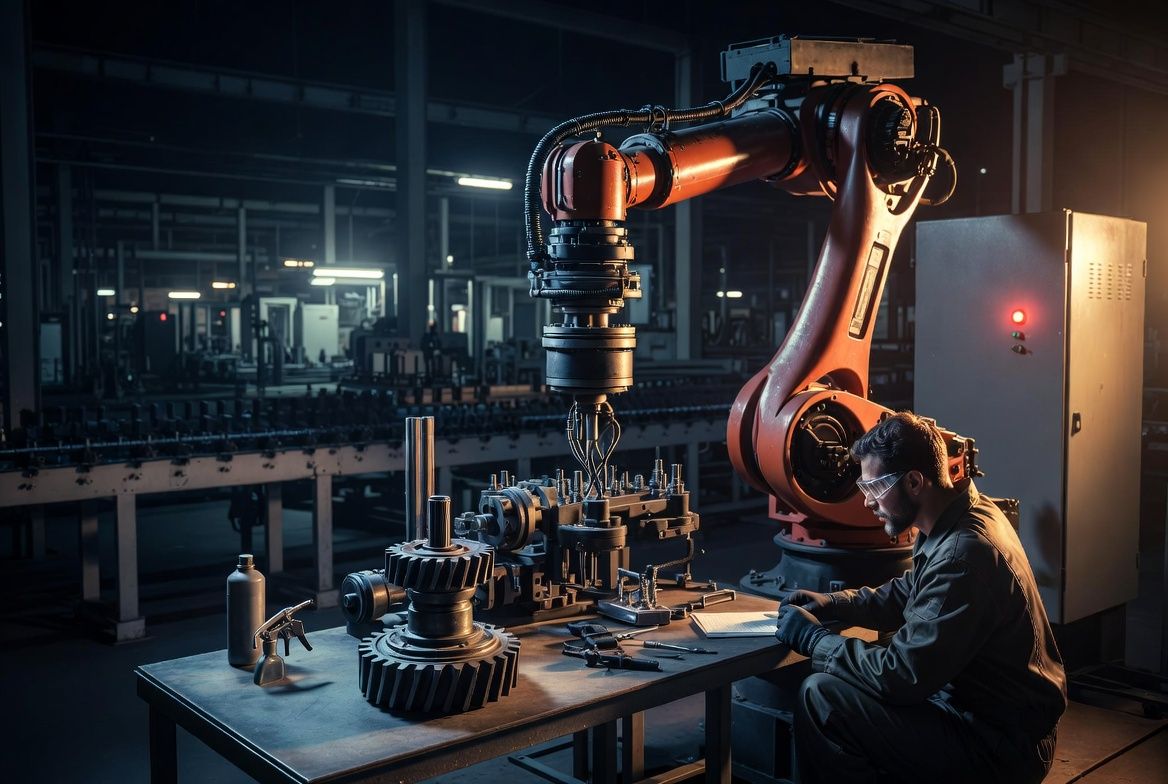
Here's a number worth sitting with: a $500 worn gear on one robot can trigger $50,000 in downtime across an entire production cell. Robots today rarely operate alone. They sit inside interconnected cells where one arm's failure stalls the stations upstream and downstream from it. The real math on maintenance stopped being about the robot a long time ago. It's about everything the robot is connected to.
Facilities that run a disciplined preventive maintenance program sustain 95%-plus uptime on their robotic cells, according to industry benchmarking. Facilities that don't tend to hover around 80 to 85%, which works out to hundreds of lost production hours a year. That gap doesn't show up in a sales demo. It shows up eighteen months in, usually at 2 a.m. on a Tuesday, when a robot that ran flawlessly out of the box suddenly starts throwing fault codes nobody prepared for.
Part of the problem is timing, and it catches even well-run plants off guard. Servo motors typically ship in two to six weeks. Reducers and gearboxes, the components most likely to actually fail, run four to twelve weeks lead time. That's the scary one. A plant that hasn't stocked spares or built a relationship with a service partner before the failure happens isn't looking at a quick repair. It's looking at a production line sitting dark for a month, waiting on a part that should have been on a shelf.
Grease management alone tells you how much this gets underestimated. Too little grease and reducers wear out early. Too much, and excess grease builds pressure inside the gearbox, blows past seals, and ends up contaminating product on the line below it. Getting it right isn't complicated, but it takes discipline and someone who's actually done it on this exact robot before, not someone reading the manual for the first time mid-repair.
This is exactly the shift industry analysts keep flagging for 2026: the story in robotics isn't going to be flashier machines, it's going to be robots that run continuously, independently, and predictably at scale. Buyers are shifting the questions they ask before a purchase. Less "what can it do," more "what happens when it breaks, and who's there when it does."
And that's the honest truth about buying a robot: the sales conversation is about capability. The conversation that actually decides whether the investment pays off is about serviceability. Grease intervals. Spare parts on the shelf before you need them. A technician who has already seen this exact failure mode somewhere else, instead of learning it live on your production floor while the line sits idle.
There's a pricing angle here too, worth watching as the industry matures: more robotics-as-a-service models are pricing around uptime and output instead of just the upfront hardware cost. That's not an accident. It's an acknowledgment that the sticker price was never the number that mattered most.
The condition-based approach that's replacing calendar-based maintenance is worth understanding too, even at a high level. Instead of servicing every robot on a fixed schedule regardless of how hard it's actually running, condition-based maintenance tracks real signals per unit, like joint cycle counts, vibration, and motor temperature, and flags issues before they become failures. It's a better model than "grease it every six months whether it needs it or not," but it only works if someone is actually watching the data and knows what a bad reading looks like on your specific equipment, not a generic dashboard alert nobody has time to chase down.
That's the conversation we have with every client at Robo Reliance, because we've had it in the field, not just on a spec sheet. Post-deployment is where the real cost of a robot gets decided, and it's where we operate.
Robo Reliance | https://www.roboreliance.com | 800-838-0156 | info@roboreliance.com